
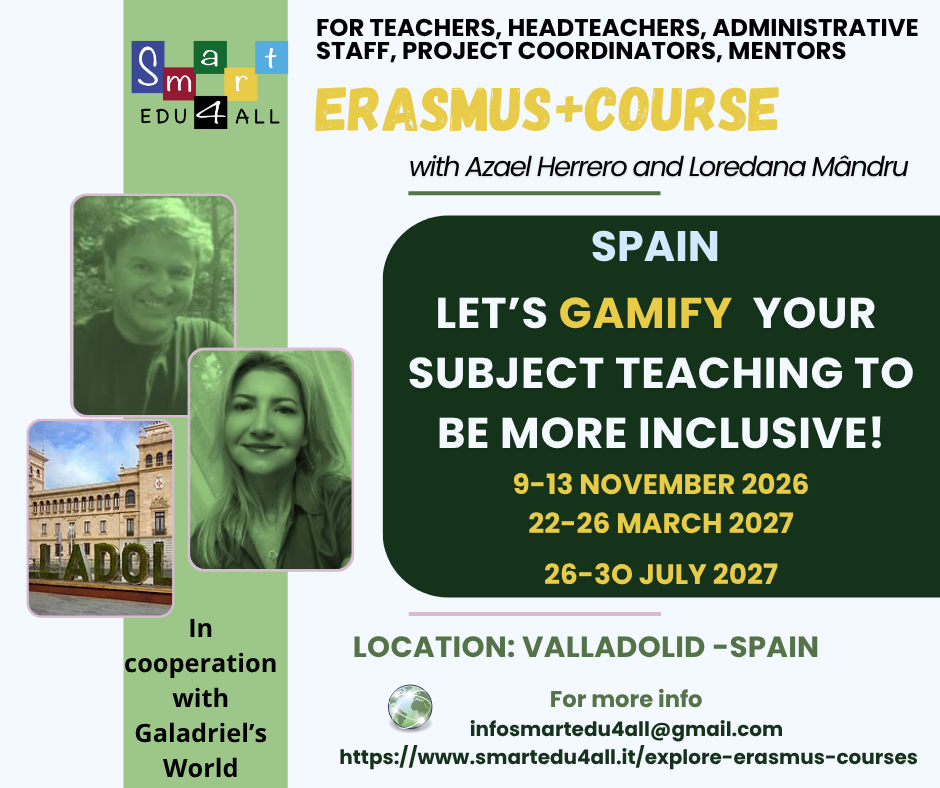
Gamification is an active teaching methodology that takes elements from the world of games, board games and video games to enhance student engagement, motivation, and learning outcomes. Techniques such as storytelling, points, badges, leaderboards, challenges, and rewards are used to create a more interactive and enjoyable learning experience. By making learning activities more game-like, we aim to boost participation, foster collaboration, and encourage a growth mindset among students.
Unfortunately, many people believe that gamifying implies gaming or use of board games, when it is not. In this course, the differences between gamification, serious games and game-based learning methodology will be explained.
It is a practical course, where teachers will be taught how to teach their subject using gamification, starting from the curricula, topics’ planning and the classical lesson plans, following keys and steps in order to succeed, including adaptations for students with special needs.
In addition, multiple examples of gamification that have been successful will be given, from different levels of education.
Target audience
Teachers of different subjects: pre-school level (3-6), primary level (6-12), secondary level (12-18), special needs, vocational, university and special needs teachers; Administrative staff; educators; Project Coordinators; Mentors
Tuition
22 hours
Objectives
The main objectives of this program are:
- Understand what gamification is and what it is not
- Understand the benefits of gamification in learning
- Know gamification model and its elements
- Analyze different successful gamified experiences
- Experience different ICT gamification tools
- Learn the key elements of storytelling and boosting of creativity
- Create a gamified action plan for a chapter of the teaching subject chosen by each participant, so that they are able to apply it in school and to explain to their colleagues the methodology
Methodology
The program of the course is designed interactively, along with discussions and individual and team exercises. The participants will also receive material related to the theoretical part explained by the trainers, together with practical examples. When the ICT gamification tools are explained, the teaching will be holded in a computer lab (or a computer is needed). Each participant will also use his/her mobile phone during some classes. At the end, each participant (or in groups of 2) will prepare his own action plan to use in the classroom (example), which will be presented to the others and feedback from the trainers will be offered.
Content
- Gamification: what is and what is not
- The benefits of gamification in teaching and learning process, starting from the diversity in the class and need for inclusion
- Types of students in the class
- The Gamification model and its elements
- Successful gamified experiences
- Tools to gamify
- Storytelling, narratives and creativity
- Steps to gamify a subject teaching: how we start, how we gamify, how we teach the new content, how we offer feedback, how we evaluate
- Practical activity: gamify a chapter of your subject teaching and receive feedback from colleagues and trainers
Participants
Minimum number: 8 – Max number: 20
Language
English
Dates
9-13 NOVEMBER 2026
22-26 MARCH 2027
26-30 JULY 2027
Provider OID: E10402883 – GALADRIEL’S WORLD -Pio del Rio Hortega 2,bajo-47014 Valladolid
COURSE VENUE: Colegio Jesuitinas- Ctra.Segovia 1, 47012 Valladolid,SPAIN
Cost
450€
including: tuition fee for 5 days course, half day gamified city tour, learning materials, organizational costs
The course finishes on Friday at 13:00 so that participants can transfer to Madrid.
Info and registration
TRAINERS
For registration and info write to: infosmartedu4all@gmail.com
Link to application form: https://forms.gle/inzQhuAeancYcopE9
Azael Herrero – professor at the Universidad Europea Miguel de Cervantes (Valladolid, Spain), where he teaches Research Methods and Statistics. He holds a European PhD in Sport Sciences. He is passionate about board games and has developed a board game-based learning methodology that can be applied to children, adults and the elderly. He has coordinated different projects on this methodology, and about design of serious games and/or gamification. He is a trainer of trainers and a trainer for the SALTO platform in all these areas.
Loredana Mândru – psychotherapist, co-founder of the private school Lorelay Primary School, in Iasi, Romania, trainer, trainer of trainers, former primary school teacher, former collaborator in the University of Psychology, collaborator in the adaptation and translation of psychological materials into Romanian, coordinator of several eTwinning and Erasmus projects (board games, inclusive breaks, gamification, prevention of bullying, prevention of addictions, school-parents cooperation, etc.) She loves sharing her experience as a trainer with teachers from Europe in international programs, working with parents in children’s education and organizing personal development workshops for children and adults.
A video from a previous course