
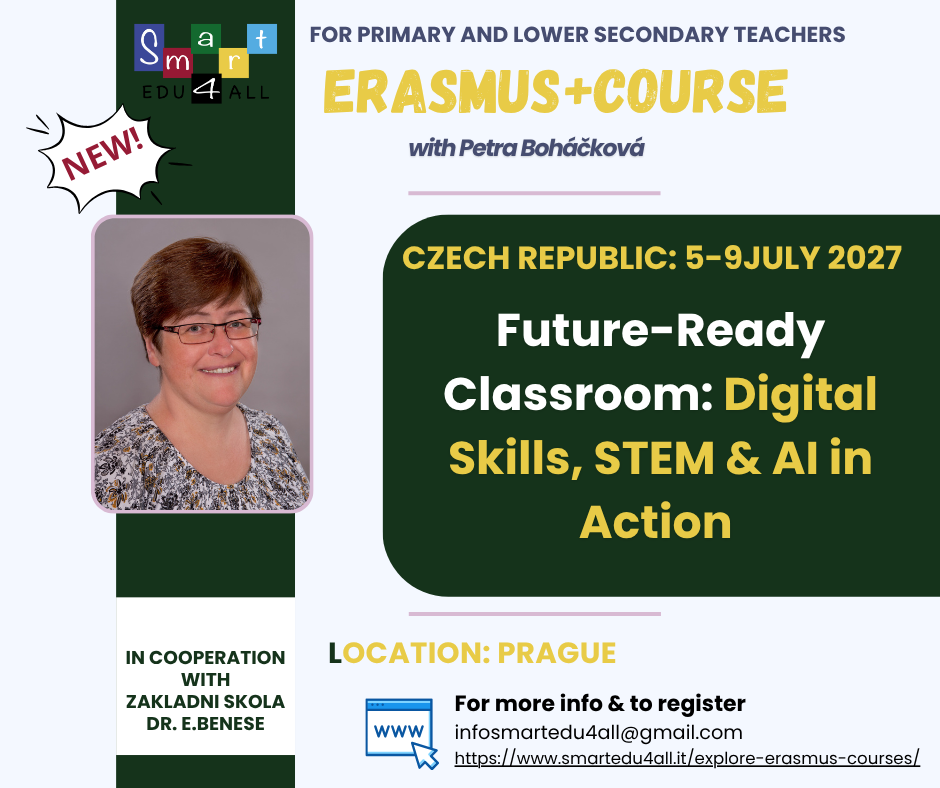
Digital competence, STEM education and artificial intelligence are rapidly becoming essential parts of modern teaching. This practical course helps teachers explore how these areas can be meaningfully integrated into everyday classroom practice.
The course is strongly hands-on. Participants will experience activities from the learner’s perspective, experiment with digital and AI-powered tools, solve STEM challenges and design their own classroom-ready activities.
The course explores how technology can support active learning, creativity, collaboration, problem solving, critical thinking and student engagement.
Participants will leave the course with practical ideas, tested activities and adaptable resources that can be immediately used in their own classrooms.
The programme combines short theoretical inputs with hands-on workshops, collaborative challenges, experimentation, peer learning and practical lesson design.
Target audience
Teachers of different subjects: primary/secondary level (8-13), special needs
Tuition
20 hours
Monday; Tuesday; Wednesday 9:00/13:00 – Thursday 9:00/14:00 – Friday 9:00/12:00
Objectives
By the end of the course, participants will be able to:
- integrate digital competence into everyday teaching;
- design engaging STEM and inquiry-based activities;
- use digital technologies to support experimentation and problem solving;
- use generative AI effectively and responsibly;
- design learning activities that develop students’ AI literacy and critical thinking;
- combine physical, digital and AI-supported learning;
- select technology according to learning objectives rather than novelty; create adaptable classroom activities for their own subjects and age groups.
Methodology
The course is designed to be interactive. Participants will work in groups and also as a part of a team. They will receive links to resources that they can use to develop their own digital competences and those of their pupils. The course follows a learn by doing approach. Participants will spend most of the course experimenting, creating, solving challenges and reflecting on how individual activities can be adapted to their own teaching context.
Content
- Digital competence in everyday teaching
- Explore, build, test and improve
- From physical experiments to digital creation
- From prompting to critical thinking
- Designing learning for the future
Day 1 – Information, AI, Media & Fake News
Exploring how we consume and evaluate information in the digital world. We will focus on fake news, misinformation, reliable sources, AI-generated content and practical strategies that can be used with students.
Day 2 – Sensors & Exploring the World
Using sensors and simple digital technologies to observe and measure the world around us. Participants will try hands-on activities combining science, data collection and basic programming.
Day 3 – Data, Evidence & Critical Thinking
Working with data and evidence: collecting, visualising and interpreting data, recognising misleading representations and discussing how data can be used to support or challenge claims.
Day 4 – STEM, Coding & Robotics
Practical STEM challenges combining science, technology, engineering and coding. We will explore how tools such as micro:bit, sensors and simple robotics can be used for modelling, problem solving and interdisciplinary learning.
Day 5 – From Ideas to Classroom Practice
Connecting the different elements of the week and designing meaningful learning activities for students. We will also explore citizen science and opportunities to involve students in real-world research and data collection.
The programme is intended as a flexible framework rather than a fixed schedule. We will be happy to adapt individual topics and activities to the participants’ experience, interests and needs. We are also very open to other suggestions or specific areas that participants would like to explore during the week.
Participants
Minimum number: 8 – Max number: 20
Language
Trainer
English
Petra Bohackova – She is a member of GEG Teach with Us, a leading ambassador of Future classroom lab European schoolnet, an Apple Professional Development Trainer since December 2014 and an Apple Distinguished Educator since 2015. Petra graduated from the Faculty of Education, Charles University, majoring in physics – fundamentals of technology. Gradually she finished her studies in English and Environmental Education. She currently teaches physics and English at the Dr. E. Beneš Primary School in Prague 9 – Čakovice and works there as a deputy
Dates
5-9 July 2027 – Prague
COURSE VENUE: ZAKLADNI SKOLA Dr. EDVARDA BENESE – Namesti Jiriho Berana 500, Praha 9 – Cakovice Czech Republic
OID OF THE COURSE PROVIDER ZAKLADNI SKOLA Dr. EDVARDA BENESE: E10159851
Cost
450€
including: tuition fee for 5 days course, learning materials, organizational costs
Info and registration
For info write to: infosmartedu4all@gmail.com
link to application form: https://forms.gle/XvUVWQJe5MwxEXoV8
BELOW A VIDEO FROM A PREVIOUS COURSE RELATED TO DIGITAL COMPETENCES IN THE CLASSROOM with Petra