
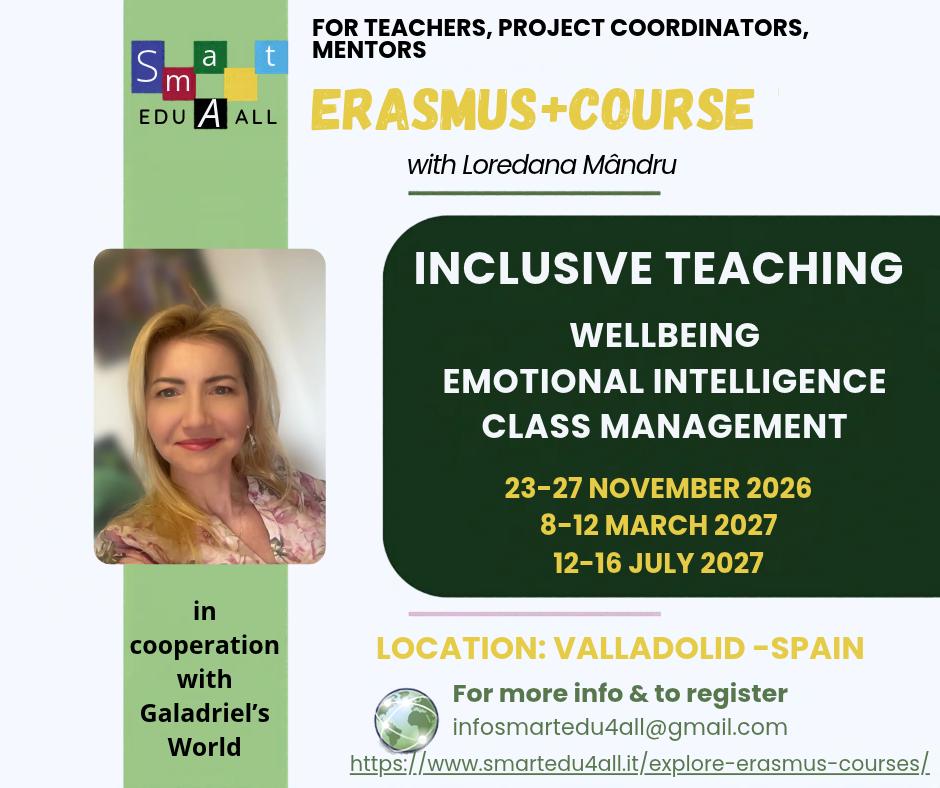
Building a classroom where every pupil belongs
Every class is diverse. Pupils arrive with differen.t emotions, needs, rhythms and ways of learning. Inclusion means that each of them feels safe, seen and supported, and is therefore ready to learn.
This course presents class management as the basis of inclusive teaching and of pupils’ wellbeing. Teaching is also an emotional practice: emotions influence attention, behaviour and learning, while the teacher plays an important role in shaping the emotional climate of the classroom. Good class management is not only about rules and discipline. It is about relationships, belonging, emotional intelligence and routines that help every pupil take part. We call this the invisible classroom. Participants experience a wide range of practical activities: getting-to-know and belonging games, emotional check-ins, brain breaks, mindful moments, cooperative games, modern board games, learning stations, and rhythm and movement activities. Activities are supported by guided reflection and discussion on how they can be adapted to different ages, subjects, classroom contexts and pupils’ needs.
Throughout the course, participants experience classroom routines that model how to create structure, connection and a sense of belonging.
Target audience
Teachers from pre-school to secondary, vocational and special needs education, as well as educators, mentors, project coordinators and school staff who work with pupils.
Tuition
22 hours – hours in the afternoon plus one morning
Objectives
The main objectives of this program are:
- Look at inclusion through the eyes of the pupil and understand the role of belonging in learning and wellbeing.
- Understand teaching as an emotional practice and the link between emotions, behaviour and learning.
- Develop pupils’ emotional intelligence: recognising, naming and regulating emotions in class.
- Use brain breaks and short mindful moments to support attention, emotional regulation, wellbeing and participation in inclusive classrooms.
- Communicate clearly and assertively with pupils, and listen so that every pupil feels heard.
- Respond to learner diversity through flexible teaching strategies, cooperative learning, game-based learning and varied opportunities for participation and expression.
- Build routines, class agreements and fair rules, and set boundaries that are both firm and kind.
- Develop positive habits of mind in pupils: confidence, persistence, organisation, getting along and resilience.
- Design classroom activities and a personal plan for a more inclusive class.
Methodology
The course is interactive and practical: participants experience each activity as pupils, then step back and analyse it as teachers.
- Learning by doing. Games, movement, role-play, group and individual exercises.
- Debriefing and adaptation. Experiential activities are supported by guided reflection: what happened, what participants learned and how activities can be adapted to age, needs, class size and subject.
- Routines modelled in practice. Greeting at the door, emotional check-ins, rhythm activities and exit tickets: routines participants can adapt and use back at school.
- Short, research-informed theory. Inclusion and belonging, emotional intelligence, social and emotional learning, learner diversity, Universal Design for Learning and cooperative learning.
- Real classroom situations. Participants bring cases from their own classes and work on them in groups and through role-play.
- Transfer: From the training room to my classroom. A daily reflection; ideas are collected on the Inclusive Classroom Wall and become each participant’s personal plan on the last day.
- A toolkit to take home. Activity descriptions, a participant notebook, resources and bibliography.
Content
Training modules
- Every pupil is different. Diversity, inclusion and belonging; the whole child; Universal Design for Learning principles; what makes a good teacher; teaching as an emotional practice.
- The emotional classroom. Emotional intelligence; recognising emotions in pupils; tone of voice and body language; the teacher’s emotional reactions; mindful teaching; brain breaks and short regulation activities as inclusive tools to support attention, participation, transitions and readiness to learn.
- Communication and connection. Listening; assertive communication; flexible ways of learning and participating; learning stations; modern board games and the power of debriefing.
- Class management. The invisible classroom; routines for every moment of the school day; class agreements and rules; teacher boundaries; class management in special circumstances; positive habits of mind.
- Cooperation and belonging. Cooperative games, rhythm, movement and stories; giving and receiving feedback; a personal plan for an inclusive classroom.
Expected outcomes
By the end of the course, participants will be able to:
- create a sense of belonging and a positive class culture that supports pupils’ wellbeing;
- use routines for the start, transitions and end of the school day;
- support pupils in recognising and managing their emotions;
- use brain breaks, mindful moments and cooperative games to include every pupil;
- build class rules and agreements together with pupils, and keep boundaries that are firm and kind;
- adapt activities for different ages and needs;
- apply a personal plan with concrete practices for their own class.
Participants
Minimum number: 6 – Max number: 20
Language
English
Dates and course venue
23-27 NOVEMBER 2026
8-12 MARCH 2027
12-16 JULY 2027
Provider OID: E10402883 – GALADRIEL’S WORLD -Pio del Rio Hortega 2,bajo-47014 Valladolid
COURSE VENUE: Colegio Jesuitinas- Ctra.Segovia 1, 47012 Valladolid,SPAIN
Cost
450€
including: tuition fee for 5 days course, learning materials, organizational costs, certificate of attendance. The course finishes on Friday at 13:00 so that participants can transfer to Madrid.
Info and registration
Trainer
Write to: infosmartedu4all@gmail.com to get more info.
Link to application form: https://forms.gle/NVLRzriaxdiHWbBQ7
Our three courses – which one is for you?
- Harmony in Practice – focus on yourself: the wellbeing of teachers and school staff (body, mind, emotions, relationships).
- Inclusive Teaching – focus on your class: emotions, routines and class
management so that every pupil belongs. - The Leader Inside Each Teacher – focus on your influence: leading colleagues and inspiring pupils.
The three courses complement one another, each offering a distinct focus, learningexperience and practical applications.
Loredana Mândru
Loredana Mândru is a former primary school teacher, psychotherapist and international teacher trainer with more than 20 years of experience in education.
She began her career in the classroom and still looks at education from the pupil’s desk: what helps a child feel safe, seen and ready to learn. She later co-founded and now leads Lorelay Kindergarten and Primary School in Iași, Romania, a school built around belonging, emotional learning and respect for the different ways children learn. Many of the activities in this course have been tried and adapted in real classes, with pupils with very different needs.
As a psychotherapist, she brings an understanding of emotions, behaviour and relationships: what lies behind a pupil’s behaviour, and how the teacher’s response can change it.
Her work in adult education began in 2004, as a teacher trainer and as a university assistant and mentor at the Faculty of Psychology and Educational Sciences. She has coordinated eTwinning and Erasmus+ projects, including a project on brain breaks for learning, wellbeing and inclusion, and facilitates Erasmus+ courses in English for teachers from across Europe.
One principle guides her work: every child learns better when they feel they belong.
A video of a previous course