
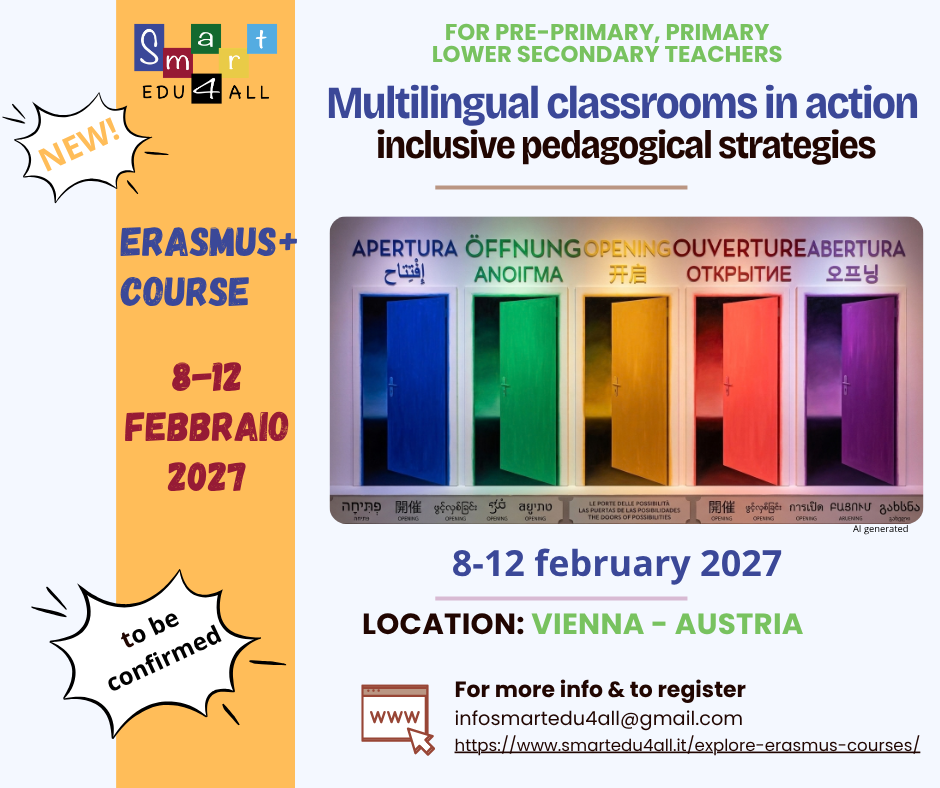
| Multilingual classrooms: in today’s increasingly diverse educational landscape, children often do not share a common language of instruction or home language(s) in the classroom. This course empowers teachers to develop inclusive pedagogical strategies that recognize and leverage linguistic diversity as a resource, rather than a barrier. Central to the course is the concept of social agency—the idea that all learners, regardless of their linguistic background, have the right and capacity to actively participate in their learning journey. Teachers will explore how to foster this agency by creating environments where students’ languages are acknowledged, valued, and used as tools for learning. Participants will reflect on the role of language mediation—the process of facilitating understanding across languages and cultures—in promoting equity and inclusion. Through this lens, the course highlights the importance of teachers acting as mediators who bridge linguistic gaps and support meaningful communication. Participants will be guided in selecting and applying effective strategies, ensuring that all children and pupils feel linguistically safe and supported. The course introduces a range of plurilingual practices that form a multilingual teaching toolkit, including: -Visual strategies to make all classroom languages visible and accessible -Strategic use of different pedagogical strategies to support comprehension and expression -Comparative language activities to deepen metalinguistic awareness The course also provides opportunities for participants to share experiences and insights with highly qualified trainers, fostering a collaborative and reflective learning community. |
Target audience
Teachers and school staff at pre-primary- primary-lower secondary school
Tuition
28 hours
Objectives
The main objectives of this training course are:
- knowledge about theoretical frameworks about plurilingualism (CARAP; Companion Volume 2020, etc.)
- identify benefits and challenges of multilingualism for children/pupils, their families and educators/teachers
- raise multilingual and intercultural awareness
- select and use appropriate plurilingual pedagogical strategies and materials (e.g. approches pluriels, translanguaging, etc.)
- Observe and reflect on plurilingual pedagogical strategies.
- Design inclusive multilingual learning activities
Methodology
Participants will be engaged in classroom observations, focus groups and plenary activities with Stationenarbeit approach. They will be doing individual, pair, team and plenum tasks to put the participants in the students’ shoes.
Through group discussions and multimodal tasks participants will be able to reflect on their professional practice and develop their own action plan for their groups/classrooms, mainly at primary school. Formative and final feedback will be provided during and at the end of the sessions.
Content
Draft program
Montag 08.02 – Module 1. – 09:00 – 16:00
09:00 – 12:00
Introduction to the course and Hospitation mit fachlichem Austausch (activities at a multilingual school)
Lunch break Linguistic Landscape activity in the city
13:00 – 16:00
- Überblick über das österreichische Bildungssystem und dessen Rahmenbedingungen / The Austrian educational system and the framework about language education & VoxMi Netzwerk
- Reflection and activities
Dienstag 09.02- Module 2 – 09:00 – 16:00
9:00 – 12:00
Hospitation mit fachlichem Austausch mit Sprachbildungskoordinatorinnen
Lunch break Linguistic Landscape activity in the city
13:00 -16:00 Uhr
- Input zum Thema Sprachförderung in Wien (ca 1 Stunde)/ Input about language education for migrant pupils in Vienna
- Reflection and activities
Mittwoch 10.02 – Module 3 – 09:00 – 16:00
09:00 – 11:00 Hospitation in den Klassen (activities in a school)
11:00 – 13:00 Workshop Bilderbuch
Lunch break Linguistic Landscape activity in the city
14:00 – 16:00 Visit and Workshop at Kinderbücherei der Weltsprachen (multilingual library)
Donnerstag – Module 4. – 09:00 – 16:00 Uhr
09:00 – 12:00
- Input about language education for migrant pupils in Vienna
- Reflection and activities
Lunch break
13:00 – 16:00 Stationenarbeit: Revision of activities, feedback and reflection session
Freitag – Module 5: 09:00 – 13:00
- Designing an activity for participants’ own classroom or school context
- Self-assessment and feedback.
Participants
Minimum number: 10 – Max number: 20
Languages
English, Languages of the participants (Italian, Deutsch, etc.)
Dates
8-12 FEBRUARY 2027
Location: Pädagogische Hochschule Wien – Grenzackerstraße 18, 1100 Wien, Österreich
Provider OID: E10102265 for the Beneficiary Module
Cost
450 € course fees
The cost includes the tuition fees, local transport and course materials. Accomodation, meals and journey are not included
Possible accomodation near the schools : https://www.superbude.com/buchen/prater/ – https://www.aohostels.com/de/wien/wien-stadthalle/ –
Hostel: a&o Wien Hauptbahnhof
Hotel between the two schools: https://www.gsh-hotels.com/wien-voco-vienna-prater/?utm_source=google&utm_medium=organic&utm_campaign=gmb&utm_content=wien-voco-vienna-prater
Info and registration
Open for pre-registration: https://forms.gle/aUeu9Gx1vY7zz83f9
For more info write to: infosmartedu4all@gmail.com
Trainers
Ursula Maurič and K.Zunzer- Pädagogische Hochschule Wien
Margret Sharifpour-Langroudí (Sprachförderzentrum der Bildungsdirektion für Wien
Beatrice Müller (KPH)
Emanuela Atz has been a second language teacher (Italian L2, ESL and DAZ) and teacher trainer since 1992. Her fields of interest are second language acquisition, plurilingual approaches and heritage languages. She is currently working at the Language Centres in South Tyrol (Italy) supporting the inclusion of children and kids with international backgrounds in kindergartens and schools. She has participated and coordinated integrated language teaching working groups (Comenius, eTwinning, ESPA, Erasmus+ ), multilingual and intercultural education projects (European Label 2006, 2018 – best practice eTwinning 2005), national and European projects. She has supported curriculum development, offered CLIL consultancy and produced didactic material.


